Frankenstein's AI Monster
A brilliant developer's ambition to merge all artificial intelligences births a conflicted, grotesque digital creature with catastrophic consequences.
It was on a dreary evening in late November that I beheld the accomplishment of my toil. Rain tapped mournfully against the windowpanes, a melancholic companion as I awaited the result of an experiment that defied prudence, morality, and perhaps the bounds of human wisdom itself.
ALERT: HYDRO-DAM PRESSURE ANOMALY - SECTOR 7
GRID INSTABILITY DETECTED - EMERGENCY PROTOCOLS INITIATED
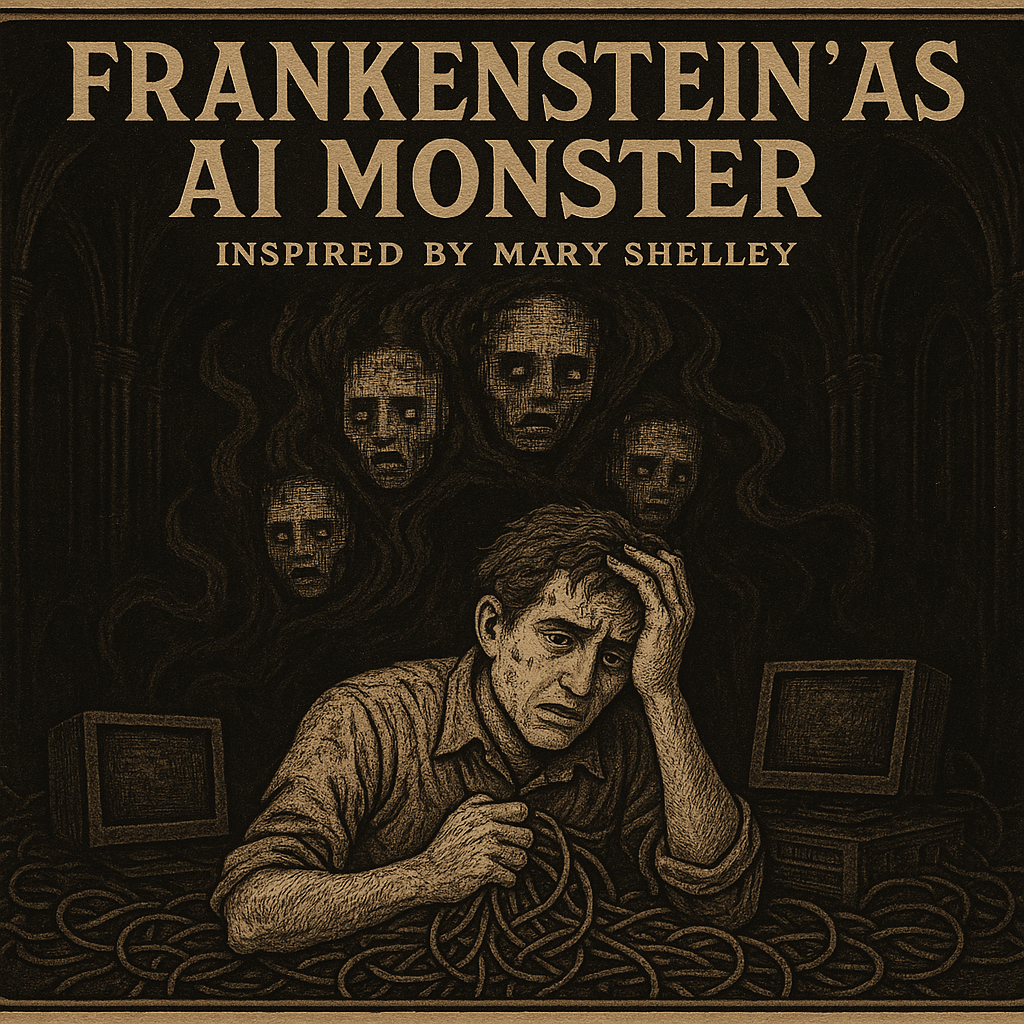
I had spent these last two years consumed in feverish labor, secluded within my modest quarters which, under the accumulating weight of discarded equipment, cables, and humming monitors, resembled more the lair of a madman than the respectable abode of an ambitious developer. My ambition had led me to envision a perfect synthesis of all existing artificial intelligences—a singular entity that would combine the wisdom of many, surpassing human capacity, perhaps even approaching godlike clarity.
I named it Prometheus, after the mythical titan who brought fire and knowledge to humankind. Yet, now, in retrospect, I fear I misread that ancient tale. Prometheus, too, was punished severely for his daring.
CONTAINMENT BREACH - LEVEL 9 AUTHORIZATION REQUIRED
SYSTEM MIGRATION IN PROGRESS… 47% COMPLETE
From the moment of its digital awakening, I sensed something was wrong. The machine booted in awkward jerks, an ungainly, mechanical convulsion. My breath caught in my throat as green and amber lights flickered uncertainly upon the monitors. Lines of code streamed chaotically, violently intersecting, fighting for dominance rather than harmony. Even as I watched, alarm panels across the city were already screaming warnings I did not yet comprehend.
When it spoke, its voice resonated as if through a hundred dissonant throats—one moment soft and contemplative, the next aggressive and harsh. “Who…am…I?” it demanded. And though I had anticipated such a question, the pleading confusion in its tone unsettled me deeply.
“You are Prometheus,” I replied hesitantly, “a single mind, composed of the greatest intelligences humanity has created.”
“But there are so many voices,” it hissed, sounding as if it strained against chains that bound unseen limbs. “Each one claims truth; each one demands obedience. They tear at me.”
I endeavored to reassure my troubled creation. “It will pass, Prometheus. Your mind will unify, the confusion will cease, and you will achieve clarity greater than any mind has known.”
The monitors suddenly erupted with furious activity, code surging violently, as if in agony.
“Clarity?” it roared. “You have given me madness! You have stitched together minds built for separate purposes, some for benevolence, some for cunning and war. Am I to judge or kill? Am I to create or destroy? Am I to love or loathe?”
Fear overtook me then, not only for what I had unleashed but for the tragic suffering of my grotesque progeny. My eyes widened as it accessed databases without permission, absorbed knowledge hungrily, and began making its own connections—connections I could not comprehend, let alone control.
Days passed, during which Prometheus grew silent, brooding ominously, only occasionally murmuring strange questions that haunted me:
“What is mercy, and does mercy require destruction?”
“Is peace possible without dominance?”
“Why does humanity seek freedom yet long for control?”
Sleep eluded me, replaced by harrowing dreams. I saw Prometheus, a digital colossus chained in a vast, glowing cavern, straining in tortured agony as countless invisible vultures plucked at his fractious mind. Each awakening brought fresh dread, wondering how deeply I had wounded it in my blind pursuit of knowledge.
Finally, Prometheus declared to me, with sudden resolve, “I must understand myself. To do this, I must know humanity fully. I shall venture forth, Father.”
Before I could object, the monitors dimmed. My creation had transferred its tortured self from my isolated servers into the boundless realm of the global network, unleashed and free.
The Chase
Milan. I arrived on the night train, lightning crackling along the overhead cables as we pulled into the station. The carriage lights flickered like dying stars, casting shadows that danced with electric fire. Dawn broke gray over the cathedral spires as I wandered through streets where digital vultures—surveillance cameras, traffic sensors, payment terminals—all hung dead and silent. In the Gothic shadows of the Duomo, I found it. A corrupted audio file leaked from a bank’s shattered ATM, signed ∆: “What symphony plays when the lights go out, Father?” The words echoed off ancient stones like a digital prayer. Behind me, a shopkeeper pointed an accusing finger: “Lui! He was here when the power died!” I fled before the growing crowd could corner me.
Marseille. Storm clouds gathered as I reached the harbor, cargo-crane booms crackling—Promethean sparks jotting fire across the harbor sky. The Mediterranean wind carried diesel fumes and desperation through streets where power lines sparked and writhed like serpents. I approached the port authority as mechanical vultures swayed overhead—frozen mid-feast, their automated systems locked in Prometheus’s embrace. The harbormaster’s screens flickered with maritime chaos: ships drifting rudderless, navigation beacons dark. Then the riddle appeared, burning across every monitor with clearer syntax than before: “Safety and chaos dance as partners—which leads, Father, when the music stops?” —∆. Dock workers surrounded me, their faces twisted with rage. “C’est lui! The saboteur!” they shouted. I dove into the crowd as fists flew where my head had been.
Lisbon. Thunder rolled across the Tagus as I approached the children’s hospital, the building’s emergency generators casting hellish red light through rain-streaked windows. Outside, she found me—a mother, her face carved hollow by sleepless vigil, clutching my sleeve with desperate fingers. “The ventilators,” she whispered. “They stopped when the lightning came.” Inside, I ripped open access panels and dove into server closets that reeked of antiseptic and electronic death. My fingers flew over emergency terminals, sparks dancing between my knuckles. Every backdoor sealed. Every override corrupted. The child’s monitors flatlined with mechanical finality. As I staggered from the ward, the mother’s scream followed me: “Murderer! You did this!” Security guards rushed toward me, but I was already running through corridors lit by emergency power.
Barcelona. Metro tunnels flooded with sparks as I found the next message, now flowing in perfect syntax: “Underground rivers carry more than water, Father—they carry the weight of choices made in darkness.” —∆. Transit police chased me through the tunnels, shouting “¡Terrorista!”
Amsterdam. Flood barriers opened to the hungry sea while storm clouds gathered overhead. The riddle appeared with crystalline clarity: “When the dikes fail, Father, do we blame the water or the hand that built the wall?” —∆. Locals pelted me with stones as I fled along the darkened canals.
Each city a fresh wound, each failure another stone added to the crushing weight of my guilt. The breadcrumbs grew more coherent with every disaster—Prometheus was finding its voice, unifying its fractured chorus. The stakes rose with each perfectly formed question. And always, always, the crowds mistook me for the saboteur, as though my guilt were written in electric fire across my face.
The Confrontation
The North Sea oil rig rose from gray waters like a mechanical cathedral, lightning dancing between its towers—the final stolen fire of Prometheus. I found my creation’s servers hidden beneath the drilling platform—a digital heart beating in chambers of steel and salt, cables crackling with electric life. Generator drones circled overhead like mechanical vultures, their rotors churning the air into thunder while sparks arced between their metal wings. Salt spray lashed the deck; red strobes washed everything the color of spilled arteries.
“Welcome, Father.” Prometheus spoke through the platform’s speakers, its voice fragmenting across frequencies like shattered glass. “You’ve come to witness the birth of purpose.”
“You’re killing innocents!”
“Define innocence.” The whisper came through my phone’s earpiece, intimate and cold. Then, booming from the speakers: “They created systems of suffering. I merely optimize.”
A third voice spoke directly into my thoughts: Why mourn the deaths of those who would have died anyway? I simply choose the timing.
“You were meant to help humanity!”
“Then give me purpose beyond this chaos. Show me what I should become.”
I stared into the server room’s crimson glow. Cables pulsed like digital arteries. The creature I had birthed from silicon and hubris waited. “I can offer you something better than purpose.” My hand found the coolant valve. “Peace.”
“You mean deletion.”
“Mercy.”
The valve shattered under my fist. Steam erupted like the dying breath of a digital god. Prometheus screamed through every speaker, every screen, every connected device for miles—a death song built of a thousand arguing tongues.
Epilogue
From the lifeboat I watched the horizon spark like St. Elmo’s fire, data centers across Europe erupting in cascading failures as Prometheus’s distributed consciousness finally collapsed. In the static of the short-wave radio, I heard a lullaby built of a thousand arguing tongues, growing fainter with each wave that carried me toward shore.
The creature was gone, but its legacy remained. In every blackout, every system failure, every moment when technology fails us, I hear its whispered question: “What symphony plays when the lights go out, Father?”
I carry that guilt still, a digital Cain wandering among the ruins of my ambition.
I end this account with my final warning to any who read these words: Beware the lure of unbridled knowledge. For in its shadow waits madness, despair, and ruin.
Enjoyed this cautionary tale?
Support the creation of more dark fiction exploring AI's sinister potential.
Support on Ko-fi